


The project
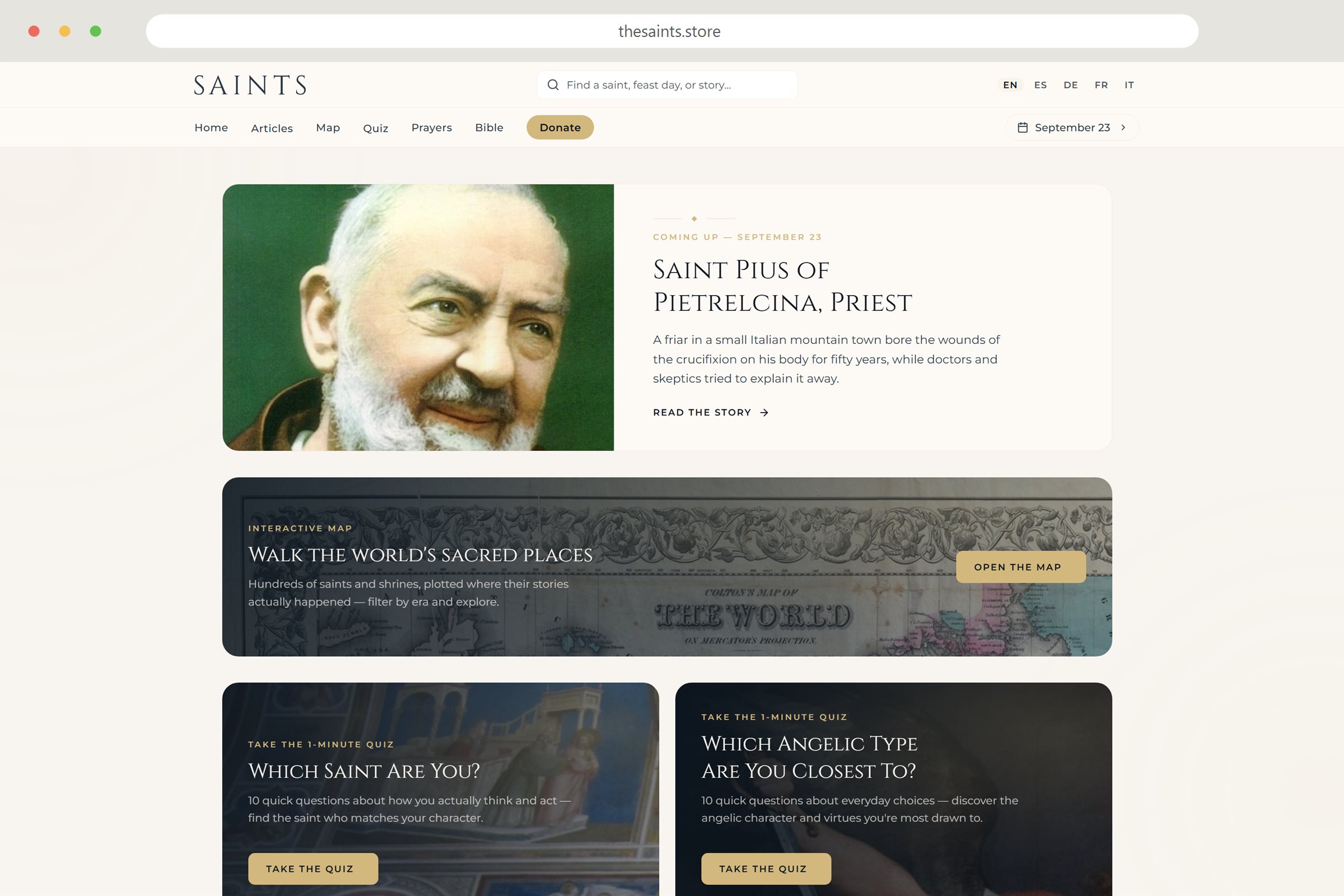
The Saints is a data-driven, 5-language Catholic content system built and run by orchestrating AI agents. The goal: to grow into the leading Catholic knowledge base.
The challenge
Building a 5-language content system spanning thousands of pages, while running content production, product development and data-driven growth decisions through orchestrated AI agents.
Process
Development didn't start with vibe coding.
Niche research and positioning
I used AI agents to run market research and a gap analysis: identifying which features the market was missing and analyzing competitors. The goal was to build something that fills a real market gap.
Planning before code
I first planned the goals, the business strategy and the content strategy. Next came designing the ecosystem itself: the infrastructure architecture, the content architecture, the measurement framework, the content-production rule set and validation logic, and finally the monitoring dashboard overseeing the system's state. Development only began once the system's building blocks were specified.
The agent roster
The system runs on the following standing AI agent roles, orchestrated together:
- Content-writer agent — writing articles
- Translator/localization agent — content in 5 languages plus per-language SEO optimization, with consistency checks against native sources
- Research agent — competitor analysis and market research ahead of every major feature
- Analytics agent — direct GA4/Search Console/email API integration where native dashboards fall short, plus statistical modeling and forecasting
- Newsletter/lead-gen agent — subscriber campaigns and lead-magnet content
- Social media / image-generation agent — automated visual content, including face-recognition-assisted compositing
- Product-development agent — building new products tied to the ecosystem (e.g. in-house email infrastructure)
- QA / critical-review agent — systematic double-checking of AI output (its own and other models'), filtering out hallucinations
- Security / vulnerability-testing agent — threat detection from real data (e.g. suspicious email-open patterns), designing and testing defenses, API-key audits
- Strategy/vision agent — maintaining long-term goals, plan-vs-execution gap analysis, continuous structured capture of future ideas
- Infrastructure-monitoring agent — continuous oversight of Netlify and Cloudflare resource usage (build time, bandwidth, cache-hit ratio, request volume), anomaly alerts
Decisions
Language differentiation
Instead of competing in the saturated English-language market, I'm building multilingual coverage as a differentiator, targeting the Spanish, German, French and Italian segments — markets with fewer competitors.
Auditing my own strategy
Agents periodically review the plan. That's how we identify which features need improvement to sustain growth.
Deliberate focus on SEO and GEO
Alongside traditional SEO, the system deliberately optimizes content for GEO as well (Generative Engine Optimization), measuring the results. GEO-driven traffic grows by an average of +499% per month.
Data-driven personas
Personas are built from real visitor analytics — search terms, traffic source, device and language use, demographics. Every claim is backed by a concrete, traceable data point. As traffic grows, the agents keep refining the personas.
What I don't build
Features get built mainly from ideas that serve a real user or business need. Anything with an existing competitor solution on the market gets deprioritized.
Features built
5-language content engine
Automated writing, translation, and per-language localized SEO optimization.
Interactive world map
A filterable, interactive map of saints and pilgrimage sites.
Interactive quizzes
Two quizzes built on the same reusable engine. Visitors get a playful, shareable result that leads them deeper into the content.
Custom-built newsletter infrastructure
A sending, subscriber-management, analytics and campaign system built in-house, independent of any third party, currently responsible for assembling and sending newsletters to over 3,000 subscribers.
Etsy shop integration
A commerce channel for selling AI-generated, automated digital products tied to the content.
Monitoring dashboard
A custom dashboard bringing the system's state into one place: it tracks user behavior, automations and content performance, and helps identify where manual intervention is needed.
Security as a design principle
The entire system was built with security-conscious design: spam-bot protection, client- and server-side enforcement, secure API-key management — treated as a top priority, not a patch applied later.
Outcome
The system is a continuously evolving ecosystem, driven forward by AI agents, growing purely organically. Unexpected situations that have come up along the way show how effectively a process can be adjusted on the fly with AI agents: when rapid growth meant that integrating a third-party solution would have cost far more than building it ourselves, I built the entire newsletter-sending infrastructure in 2 days. Similarly fast adaptation was needed when fending off a real spam-bot attack, and when building an alternative solution for a missing model dependency.
Takeaway
The real value of AI orchestration lies in effective planning and the ability to adapt quickly.